

Buy Advair (Fluticasone) Online for Steady Asthma Control
Online Pharmacy | E-Prescriptions »
- By Dr. David T. Kent MD (Otolaryngology ENT)
- Medically reviewed by Dr. Lyndy J. Wilcox MD (Otolaryngology ENT)
Buy Advair online and keep asthma or COPD symptoms steady with one inhaler that combines an anti-inflammatory steroid and a long-acting bronchodilator. Advair Diskus is taken once in the morning and once in the evening. It works in the background to reduce flare-ups, nighttime waking, and rescue inhaler use. It is designed for people whose symptoms return despite a short-acting inhaler or a low-dose steroid.
What Is Advair and How Does Fluticasone Work in It?
Advair is a combination inhaler used for long-term control. It contains two active ingredients that do different jobs in the airways. Fluticasone propionate is an inhaled corticosteroid. Salmeterol is a long-acting bronchodilator, also known as a LABA.
Fluticasone works on inflammation. That matters because inflamed airways swell, narrow, and react too easily to triggers. With regular use, the steroid part helps calm that process down. The airways become less sensitive and less likely to tighten. You do not usually feel the full benefit right away. It builds over time.
Salmeterol works in a different way. It relaxes the muscles around the airways and helps keep them open for about 12 hours. This is one reason the fluticasone-salmeterol pairing is used as a single controller inhaler. In a study of the fluticasone and salmeterol combination, patients had better lung function than with either medicine alone.
That combination is the main idea behind Advair. One part reduces airway inflammation. The other helps prevent the airway muscles from staying too tight. Together they cover two common problems at once. This is why Advair is used as a daily maintenance treatment in patients with persistent asthma and in some patients with stable COPD.
Each dose of Advair delivers both parts together. You are not treating airway narrowing and inflammation separately. The inhaler is built to address both in one routine step. Over time, that can make symptoms more predictable and daily breathing more stable. For many patients, that steady control is the real benefit of treatment.
Is Advair a Steroid Medication?
Some people search “buy Advair online” but still hesitate because they do not fully understand how the inhaler works or why it contains a steroid component. Advair does include a steroid. That part is Fluticasone propionate, an inhaled corticosteroid. But it is not the same as a steroid tablet or injection. It is inhaled into the lungs, where it works mainly in the airway lining. Only a small amount enters the bloodstream. This is why inhaled steroids are used for long-term airway control, not for the fast whole-body effect many people associate with oral steroids. They are also not anabolic steroids and have nothing to do with muscle growth.
Fluticasone helps reduce swelling and irritation in the airways. When inflammation stays lower, the airways react less to triggers. Symptoms become easier to control. The effect builds with regular use, so Advair is used as a maintenance inhaler, not as a quick-relief option. Like other inhaled steroids, it can sometimes cause local side effects such as a hoarse voice or oral thrush. These are usually manageable. Rinsing the mouth after each dose helps lower the risk.
Many patients feel uneasy when they hear the word steroid. That reaction is understandable. In Advair, the steroid part is there for a specific reason: to calm inflammation inside the lungs. The dose is smaller, the action is more local, and the goal is steady day-to-day control. A regular inhaled dose of Fluticasone is very different from a short burst of oral prednisone used during a flare. Oral steroids are used for sudden worsening. Advair is meant to help keep the airways more stable over time.
What Is the Difference Between Advair Diskus and Advair HFA?
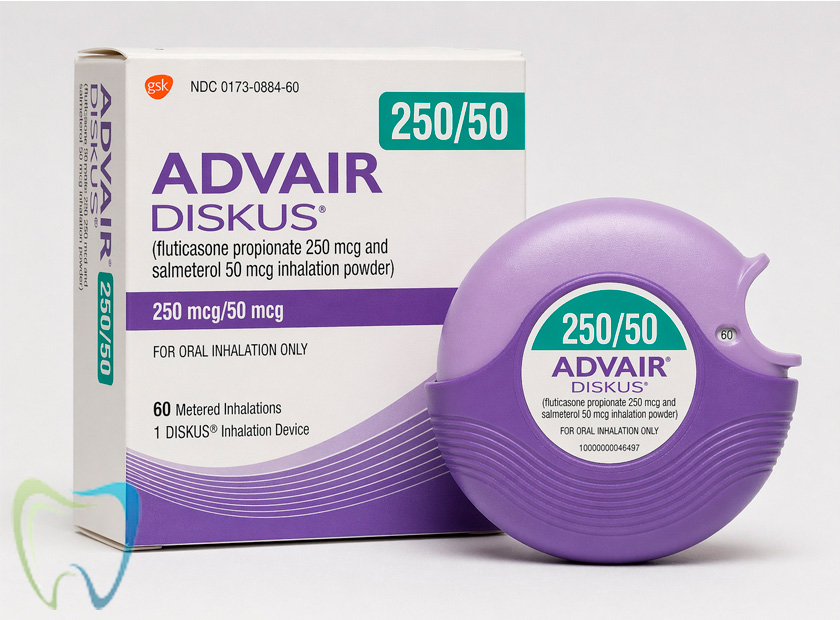
Advair is available in two forms. Diskus is a dry powder inhaler, while HFA delivers the medication as a metered spray. The active ingredients are the same in both versions, but the devices are used differently. That difference affects how each dose is inhaled and which form feels more practical in everyday use.
The Diskus is a round inhaler with a built-in powder dose. You prepare it by sliding the lever, then inhale the medicine in one strong breath. It does not need shaking and does not use a propellant. Advair HFA works more like a traditional spray inhaler. It needs to be shaken, and the dose is taken with a slow, steady inhalation. Some patients also use it with a spacer to make the process easier.
The strength options are different too. Advair Diskus comes in 100/50, 250/50, and 500/50 mcg. Advair HFA comes in 45/21, 115/21, and 230/21 mcg. The numbers are not interchangeable, so the right option depends on the clinical picture. Age, symptom control, and treatment history all matter when the dose is chosen.
Many people who read about Advair Diskus online are drawn to the powder format because it is simple to use and does not require the same hand-breath timing as a spray inhaler. Others do better with HFA, especially if a forceful inhalation is harder for them. In practice, the better form is the one a patient can use correctly and consistently.
Which Form Is Used for Asthma and COPD?
Both Advair forms are used for asthma, but they are not approved in the same way. Advair Diskus is used for persistent asthma in patients aged 4 and older. Advair HFA is used for asthma in patients aged 12 and older. That age difference matters, especially when treatment is being chosen for children and teens. If HFA is used, a spacer is often recommended to make inhalation easier and more accurate.
COPD is different. For COPD, only Advair Diskus 250/50 is approved. Advair HFA is not indicated for COPD. This is why adults with chronic bronchitis or emphysema are usually prescribed the Diskus form rather than the HFA spray. The approved strength matters here, not just the brand name.
When patients plan to buy Advair Diskus online, they often already know which form they used before. But the device still needs to match the way they breathe in. Diskus works best with a quick, deep inhalation that pulls the powder into the lungs. HFA works differently. The spray should be inhaled slowly and steadily so more of the medication reaches the airways instead of the back of the throat.
This is why technique checks matter. A clinician may ask the patient to show how they use the inhaler. Small details can change how well the medication works. Exhaling fully before the dose, keeping the Diskus level, sealing the lips around the mouthpiece, or using the right breathing speed with HFA all make a real difference. Sometimes the issue is not the medication itself, but the way the device is being used.
How Does an Online Evaluation Before Advair Work?
An online evaluation is similar to a short clinic visit, just done by video. You choose a time, connect with a licensed clinician, and talk through your breathing symptoms. If treatment is appropriate, the clinician may issue an electronic prescription. Many people who want to buy Advair online choose this option because it is simpler to fit into a normal schedule.
Before the visit, you usually complete a short medical form. It covers asthma or COPD history, current inhalers, allergies, triggers, and other medications. You may also be asked about past flare-ups, urgent care visits, or how often you rely on a rescue inhaler. These details help the clinician decide whether Advair fits your situation.
During the call, the focus is on how your symptoms look in daily life. The clinician checks how often you feel short of breath, whether symptoms wake you at night, and how well your current treatment is working. They also review safety points, including possible interactions and whether the inhaler form matches your technique. If the plan makes sense clinically, the prescription can be sent to your preferred pharmacy. If not, the clinician may suggest another step instead.
It helps to prepare a few notes before the appointment. Write down how often you use your rescue inhaler, whether you wake up at night from coughing or tightness, and what usually triggers symptoms. If you track peak flow readings, keep those nearby too. Small details like cold air, exercise, pollen, or pets can make the visit more useful and more precise.
Telehealth is useful, but it has limits. A clinician cannot listen to your lungs or examine you through the screen. For routine follow-up, controller refills, or treatment adjustments, that may be enough. For new, worsening, or unclear symptoms, an in-person visit is often the better choice. A careful clinician will make that clear when it matters.
Secure records
Follow-up support
Telehealth Otolaryngologists

How Does Advair Help Keep Symptoms Under Control?
Advair is used to make breathing more stable over time. The main result patients look for is not a dramatic feeling after one dose, but fewer symptom swings during the week. Good control usually means less tightness, fewer bad nights, and fewer days when breathing limits normal activity.
Many people who plan to buy Advair online want to know what “control” should actually look like. In practice, it often means fewer interruptions. You may wake up less at night, rely less on your rescue inhaler, and feel more comfortable during walking, exercise, or cold-weather exposure. The change is usually gradual, but it should become noticeable in daily life.
For COPD, the benefit is often measured the same way. Symptoms feel more even, flare-ups happen less often, and normal routines become easier to maintain. A review of fluticasone and salmeterol combination therapy in COPD found better lung function, fewer exacerbations, and better quality of life than with single-agent treatment.
Knowing what Advair can and cannot do makes treatment easier to judge in real life.
- What Advair does: lowers daily airway inflammation and keeps airways open for hours.
- What Advair supports: fewer nighttime awakenings, steadier breathing, less need for a rescue inhaler.
- What Advair does not do: relieve sudden breathing attacks. Always keep your rescue inhaler nearby.
- What Advair needs from you: daily use at the same times, correct technique, and mouth rinsing.
- What signals a problem: rising rescue inhaler use, more nighttime symptoms, or lower peak flow readings.
One of the easiest ways to judge control is to look at simple patterns. A short symptom log can help. Write down rescue inhaler use, nighttime symptoms, and days when breathing feels worse than usual. If those signs start to increase, it is easier to review treatment early instead of waiting for a full flare-up.
Triggers still matter, even when medication is working well. Smoke, dust, pollen, strong scents, and respiratory infections can all push symptoms upward. The goal is not only to use Advair consistently, but also to make symptom control easier to maintain from week to week.
How Is Advair Treatment Usually Chosen?
Advair is not chosen by name alone. The first step is the diagnosis. Then the clinician looks at symptom control, past inhaler use, and how often rescue medication is needed. The goal is to match the form and strength to the real pattern of the disease.
The device matters too. Some patients do well with a dry powder inhaler. Others find a spray inhaler easier to use. Age, inhalation technique, and treatment history also affect the choice. That is why the same brand can still be prescribed in different forms.
People who search buy Advair online often expect the choice to be straightforward. In practice, it is more specific than that. The right option depends on whether the patient has asthma or COPD, how stable the symptoms are, and what kind of controller treatment was used before. The form has to fit the patient, not just the prescription.
For asthma, the starting point often depends on prior controller therapy. A patient stepping up from a lower-dose inhaled steroid may begin with a lower Advair strength. Someone with more persistent symptoms may need a higher one. For COPD, the range is narrower. Advair Diskus 250/50 is the approved maintenance strength.
Which Advair Strength Fits Which Situation?
The strengths below make more sense when each one is viewed in its usual clinical setting. Different doses are used for different levels of symptom burden, prior treatment, and overall control.
Why it is chosen: it gives controller support without moving too high too early.
Who it may fit: patients stepping up from low-dose inhaled steroid treatment.
Why it is chosen: it gives broader anti-inflammatory coverage when symptoms need more than a lower dose.
Who it may fit: adults with COPD and asthma patients moving up from a lower controller level.
Why it is chosen: it provides stronger inhaled steroid coverage when lower strengths are not enough.
Who it may fit: patients with persistent asthma who still have symptoms on lower-dose treatment.
Why it is chosen: some patients do better with a spray inhaler than with a dry powder device.
Who it may fit: users who prefer a metered-dose inhaler or use a spacer for better technique.
Changing strength is not something patients should do on their own. The official Advair Diskus prescribing information makes it clear that higher dosing is not automatically better. Once control is stable, some patients may even be reviewed for a step-down. The aim stays the same: enough treatment to keep control, but not more than needed.
Timing matters as well. Advair is usually taken about 12 hours apart. Morning and evening is the most common pattern. If a dose is missed, doubling the next one is not the fix. The regular schedule matters more than trying to catch up.
Once the right strength is found, it often stays in place for a long time. Follow-up visits are used to see whether control remains steady, whether technique is still correct, and whether the same dose still makes sense. Good treatment is not about staying at the highest number. It is about staying stable on the right one.
Which Advair Side Effects Need Attention?
Most people do not stop Advair because of side effects. In real use, the first issues are usually local and manageable. A dry or irritated throat, a hoarse voice, or white patches in the mouth are more common than anything serious. Good technique and mouth rinsing lower the chance of these problems. A regular schedule helps too, because rushed or uneven use often makes the inhaler harder to tolerate.
Some reactions come from the steroid part. Others are linked to the bronchodilator part. That is why side effects do not look the same in every patient. One person may notice throat irritation. Another may feel mild tremor or a faster heartbeat at the start. Most of these effects are easier to understand when they are grouped clearly instead of listed all at once.
Patients usually need more attention when a symptom does not fade, keeps returning, or starts affecting daily life. Repeated oral thrush, ongoing chest discomfort, or a fast heartbeat that does not settle should be reviewed. In people with COPD, a new cough with fever or chills also deserves a closer look, because infections can be harder to read during inhaled steroid treatment.
Some reactions should be assessed quickly. Swelling of the face or tongue, a spreading rash, or breathing that feels worse right after a dose are not routine effects. The same goes for medication interactions. Certain antifungal, HIV, and heart-related medicines can change how Advair is tolerated, so the full medication list matters, especially for patients who buy Advair online through telehealth.
Long-term treatment is usually checked in a practical way. Clinicians may review eye health, bone health, and overall tolerance during routine follow-up, especially at higher doses. Most patients do not run into major problems. The point is simply to notice changes early and keep treatment on the right track.
What Should You Know About Generic Advair?
Generic versions of Advair Diskus are already part of routine treatment. The best-known option is Wixela Inhub. GSK also released an authorized generic. For most patients, the practical question is not whether a generic exists, but whether it fits their coverage, refill plan, and device привычка.
Cost is often the first reason people look into this option. Insurance can shape the choice just as much. Some plans prefer the brand. Others push the generic first. If you plan to buy Advair online, it helps to ask early which version is available and which one your plan is more likely to cover.
In daily use, the main difference is usually the device itself. Some patients switch without much notice. Others feel the change right away. That does not always mean the treatment is worse. Often the new inhaler just needs a short adjustment period.
For many patients, the generic is a practical option. The brand may still feel easier when someone is already very used to the Diskus device. If you buy Advair online, it is worth discussing coverage, refill consistency, and device preference before the prescription is finalized.
A switch usually goes more smoothly when the patient knows what to expect. The first days are often about handling, not about a real drop in effect. A short technique check can solve most of that. Once the new device feels familiar, many users settle into it without much trouble.
If control feels different after a switch, that is worth mentioning. Sometimes the issue is technique. Sometimes the previous device simply felt easier to use. In either case, a follow-up review makes more sense than guessing on your own.
Most Common Patient Questions About Advair
About The Author

Dr. David T. Kent, MD is a board-certified otolaryngologist and sleep surgery specialist at Vanderbilt University Medical Center. He serves as Associate Professor and Director of Sleep Surgery, specializing in obstructive sleep apnea, sleep-disordered breathing, and innovative neurostimulation therapies, including Inspire therapy. Dr. Kent is nationally recognized for his research in airway neurophysiology and advanced sleep apnea treatments.
Disclaimer
The information provided on this page is intended for general educational purposes only and does not constitute medical advice, diagnosis, or treatment. Health conditions, symptoms, and treatment responses vary significantly between individuals, and there is no universal approach suitable for every patient.
Medical decisions should only be made in consultation with a licensed healthcare professional who can evaluate your medical history, current medications, underlying conditions, and individual risk factors. Information on this page should not be used to determine treatment plans, medication selection, dosage, or to assess potential medication interactions.
This content is not a substitute for professional medical care. Before starting, modifying, or discontinuing any medication or therapy, you should seek guidance from a qualified physician, pharmacist, or other licensed clinician who can provide personalized medical advice based on a proper clinical assessment.
If you have questions or concerns regarding your health, treatment options, or medications, always consult a licensed medical professional.
Related Pages